
Chris Quin's speech to Primary Industries New Zealand Summit
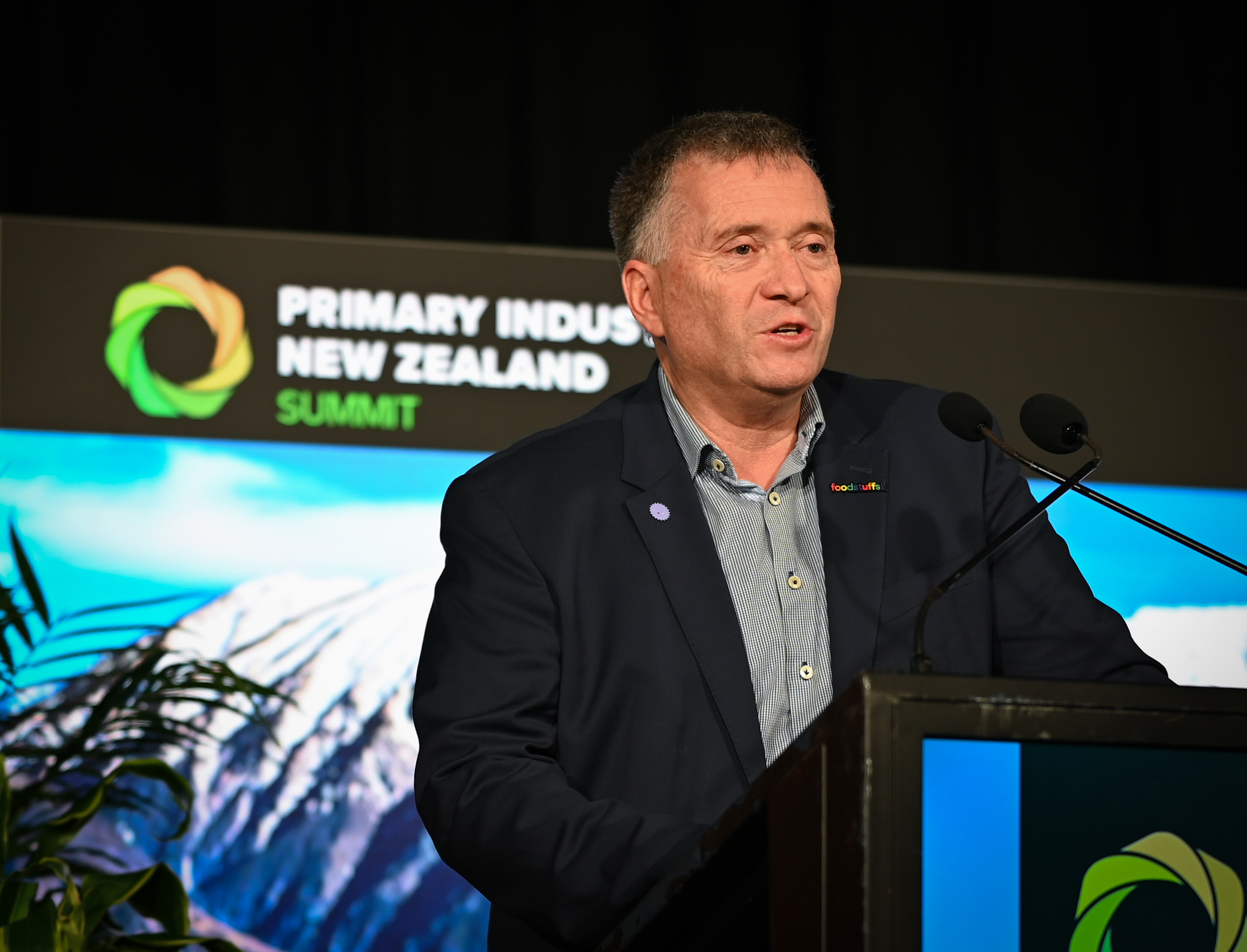
Refer to delivery.
Tēnā koutou katoa.
E ngā mana, e ngā reo, e ngā rangatira mā.
Tēnā koutou, tēnā koutou, tēnā koutou katoa.
Good afternoon everyone - thank you for having me. A supermarket guy and a Hurricanes supporter… this could be my riskiest meeting this week.
It’s a privilege to be here. It’s been a big year and month for the primary production sector at the heart of the New Zealand economy.
We don’t always talk about it this way, but food and primary production aren’t just a critical export story. This is the backbone of our productivity, our trade balance, and in many ways, our global reputation.
So, I want to start with something that is simple, but important.
Grocery is one of the largest consumer markets in the world
It’s worth around US$14 trillion annually. That’s bigger than automotive. Bigger than telecommunications. Maybe still bigger than Elon Musk. And bigger than most industries we traditionally associate with scale and transformation.
But it’s often not well understood.
Grocery can be seen as simply the end point of the food system. But I want to suggest something different. Grocery is not the end of the food system. It’s where the system gathers and receives feedback.
It’s the point where primary production meets real human behaviour.
The future of food isn’t just being decided in fields, paddocks, milking sheds, orchards, or boardrooms. It’s being decided in one place - thousands of times a minute, daily. Right there – at the checkout.
Before I go any further, it's worth explaining who Foodstuffs is.
We've been serving New Zealand communities for more than 104 years. We're often described as a supermarket chain, or half of a duopoly.
The facts are that we're a co-operative of 535 PAK’nSAVE, New World and Four Square local business owners, each family with one store, but sharing the support centre scale. Our grocers first got together in 1922 to overcome NZ’s lack of scale to share supply chain and back-end costs.
It's a model that will sound familiar to many people in this room.
Like many successful New Zealand co-ops, we've learned that scale is not just about efficiency. It's about resilience - the ability to share, support, invest, adapt and continue serving customers through changing conditions.
That's the reasons we're focused on trying to become stronger by being a national function for the co-op’s in a small and increasingly competitive market.
And it has become more competitive, despite being way smaller than many countries.
A few years ago, the major supermarkets accounted for around 82 percent of grocery spending in New Zealand. Today, that figure is closer to 77 percent.
That five-point shift represents around $1 billion in spending moving to competitors such as Costco, Chemist Warehouse, Tai Ping and Yogi-ji's.
Competition is coming from every direction. Ethnic supermarkets. Premium retailers. Big-box operators. Online meal providers. International entrants. Specialist stores.
NZ customers have more choice than ever before.
At Foodstuffs, we sit in a fairly unique position within New Zealand’s food system.
Every week, we serve around 5.3 million customer transactions. That’s 5.3 million expressions of demand. 5.3 million decisions about price, preference, habit, constraint, and choice.
And when you see that level of behavioural data consistently over time, you begin to see more than just retail patterns.
You see how New Zealanders are living, and how that is changing.
That gives us a particular responsibility. Not just to serve customers well today, but to understand where demand is heading - and what that means through the supply chain.
One of the biggest structural shifts we are all dealing with is the collapse of the time and distance between global and local trends.
Global trends are now local realities
Today, New Zealand consumers are part of the same global information and cultural system as everyone else. They see the same content, engage with the same platforms, and are influenced by the same health narratives, economic pressures, and lifestyle changes at the same time as the rest of the world.
And we see that very clearly in grocery behaviour.
And increasingly, we are seeing clear signals of GLP-1 medications influencing consumption patterns, particularly appetite, portion sizes, and category mix.
We see protein demand increasing structurally across categories. We see a strong shift towards convenience and time-saving meals. We see declining alcohol consumption in certain groups, particularly younger consumers. And the rise of Low Carb and Sugar Free and Zero.
We see increased focus on provenance and origin - where food comes from and how it is produced.
These are not abstract trends. We are already reconfiguring our stores to cater for these changes. The growth of chilled, frozen and fresh.
They are already driving decisions around what food to produce.
So, what are customers telling us? When we look across our nearly 60 billion data points through our partnership with global customer data science company Dunnhumby, three clear shifts stand out.
People are spending more carefully – “intentional buying”
Not necessarily spending less - but spending with far greater intent.
We’re seeing smaller baskets, more switching between stores and formats, a strong preference for value and growth in private label – Pams in our case.
The key insight is that people haven’t stopped spending. They are thinking much harder about every dollar.
That’s important for all of us - retailers and producers - because it changes how value is perceived.
People are changing what they want
This is where the structural change is most visible.
Across Dunnhumby’s megatrends work, we see shifts that are not cyclical - they are behavioural. We see growing cultural and ethnic diversity reshaping demand profiles, a stronger focus on health and wellbeing embedded into everyday purchasing, rising demand for convenience across almost every category, and changes in consumption patterns linked to GLP-1s that are emerging but are directionally clear.
Because what matters is not the medical technology itself, but the downstream effects.
When appetite changes, the entire system needs to adjust. That includes agriculture, manufacturing, logistics, and retail.
The challenge is no longer simply producing more food. It’s producing the food people will choose in a different demand environment.
The first megatrend I want to highlight is health
Health and wellbeing have been influencing food choices for years. What's changing now is the speed and scale of that shift.
Dunnhumby describes this as a shift towards metabolic nutrition.
The rise of GLP-1 medications is a good example. Roughly 30-50 million people globally are using GLP-1 drugs, and this has consequences.
Airlines have spent decades trying to remove weight from aircraft, from lighter seats to removing magazines, and now they may be seeing weight change in the one place they don’t control: their passengers.
In the United States, analysts have suggested lighter airline passengers could save airlines around US$580 million a year in fuel costs.
This isn't a niche trend. It's influencing how people think about food.
One US retailer described what they were seeing as the ‘half sandwich problem’ - customers still buying lunch, but only eating half of it.
Not because they were trying to cut back, but because they physically felt full sooner. That’s the kind of subtle shift that quietly rewrites demand across the entire food system which has been designed around ever increasing consumption, not less.
We're seeing growing demand for protein and fibre. We're seeing greater focus on nutrition, portion sizes and feeling full.
People are becoming more selective about what they eat because they're eating less of it.
When that happens, every bite has to earn its place.
For producers, manufacturers and retailers, that's a significant signal.
The opportunity is obvious. Consumers are looking for foods that deliver more nutritional value, more convenience and better outcomes.
But it also raises bigger questions about product formats, pack sizes and how supply chains evolve as eating habits change.
The point isn't the medication itself. The point is that customer behaviour is shifting.
And when customer behaviour shifts, the entire food system shifts with it.
The second megatrend is value
Value remains the most powerful force in how people shop for food.
To give you an example, our PAK’nSAVE brand is built on one promise: value – New Zealand’s lowest food prices.
Recently, PAK’nSAVE marked 10 years as New Zealand’s leading brand for fairness in the latest Kantar Corporate Reputation Index, while retaining second place overall.
Value is king, particularly when times are tight. But what value means continues to evolve.
Retailers in the UK coined a phrase during the cost-of-living squeeze - they called it the rise of the ‘forensic shopper’.
People weren’t just switching brands anymore. They were literally calculating the price per sheet of toilet paper on the shelf to work out which pack was best value.
That tells you something important: value has become much more analytical. People aren’t just reacting to price, but interrogating it.
Here in NZ, we're seeing many households manage budgets by cooking from scratch more often, less eating out, planning meals more tightly, and focusing on ingredients.
That’s where we’re seeing strong demand for local produce, meat, fish and poultry. People still want quality, but it has to stack up on value.
At the same time, we're seeing what you might call "treat-onomics". People are making deliberate choices so they can budget for treats.
A better block of chocolate. Keeping the haircut in the budget. Little things that make a week feel a bit more balanced.
So, value isn’t just about cheap anymore, but whether every dollar feels like it’s done its best job.
For producers, that means quality, consistency and affordability.
The third megatrend is resilience and assurance
Consumers have now lived through years of disruption.
Economic uncertainty. Extreme weather events. Supply chain shocks. Geopolitical instability.
What used to feel like short-term volatility has, for many people, become everyday life.
In that environment, resilience becomes more than an operational issue, but something people actively value and notice.
We saw this very clearly during Cyclone Gabrielle. In parts of the North Island, supermarkets still had stores and staff, but the roads disappeared overnight.
Supply chains that normally run with precision had to switch into emergency mode, rerouting freight where possible, pre-positioning stock, and in the most isolated areas - working alongside Civil Defence and the Defence Force to maintain supply.
What was interesting was how quickly supermarkets shifted from being retail operations to becoming local distribution hubs for essential goods.
And for customers, resilience stopped being an abstract concept. It became something very tangible - will the basics arrive that day?
The organisations that succeed will be those that can adapt quickly, maintain trust and continue delivering when conditions are difficult.
That requires stronger collaboration across the value chain. Greater visibility and better traceability.
And a shift in thinking, where resilience is not just about keeping things moving behind the scenes.
It is part of the value proposition customers are effectively choosing when they shop.
Across all of this, one theme consistently stands out - trust.
Consumers increasingly want confidence in what they are buying. Confidence in safety. Confidence in origin. Confidence in how food is produced.
Trust isn’t one of many factors in food choice, but the condition that allows other factors like price, quality, and convenience to matter.
For New Zealand, this has to be a structural advantage.
We already have strong foundations in food safety, animal welfare, and traceability. These are deeply embedded in how our primary sector operates.
But the important point is this. Trust is becoming a differentiator in global markets.
And like any competitive advantage, it must be actively maintained.
Bringing this all together, why does this matter for the primary sector?
First - grocery is not just retail. It is a real-time feedback system for the food economy.
Second - global trends are already local trends. What happens globally shows up in New Zealand demand quickly.
And third - the opportunity for the primary sector is not just volume growth. It is alignment with changing demand and delivering the highest value products possible. It is staying relevant to what consumers actually want.
Let me finish with a simple reflection.
Every day in New Zealand, millions of grocery decisions are made.
And each decision is a signal, about price, preference and values.
And over time, when you aggregate those signals, you begin to see where the system is heading.
So our opportunity - across the entire primary sector - is to get better at reading those signals together.
Because in many ways, we are all connected to the same system.
We are your customers, and you are our critical partners. And we all serve the same consumers.
When we get really good at listening to each other, and reading those signals, New Zealand will be positioned better to grow, adapt, and compete globally.
Thank you.