
Foodstuffs’ latest fully electric truck hits the road
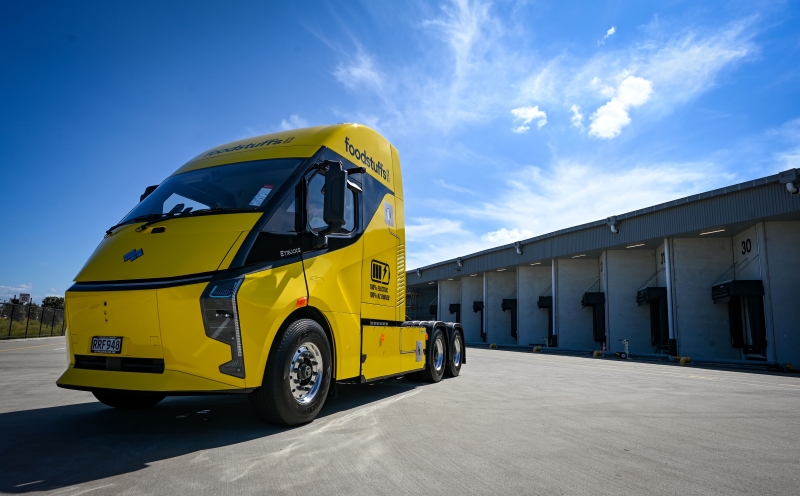
The Deepway Star electric truck, developed by Baidu and Lionbridge, will deliver chilled and frozen groceries across the lower North Island.
Foodstuffs North Island is charging ahead with the addition of a new electric truck to its supply chain fleet, set to hit the road next week.
The new Deepway Star electric truck is the latest addition to Foodstuffs’ supply chain fleet, and will operate out of Foodstuffs’ Palmerston North Distribution Centre, delivering chilled and frozen groceries to stores across the lower North Island.
Developed by Baidu and Lionbridge in Hefei, China, the Deepway Star was designed specifically for zero-carbon logistics and is Foodstuffs’ first electric heavy vehicle operating in the temperature-controlled distribution network.
The truck will tow an electric refrigerated trailer that joined the fleet in 2024, enabling the entire unit, including the refrigeration system, to operate on electricity.
Foodstuffs Head of Environmental Social Governance Sandy Botterill says electrifying heavy freight is one of the most important steps Foodstuffs can take to cut emissions.
“About 70 percent of Foodstuffs’ Scope 1 and 2 emissions come from our supply chain fleet, so transitioning heavy vehicles away from diesel is critical,” Botterill says.
“We’ve set a target to reduce emissions by 42 percent by 2030 from our 2020 baseline, and projects like this move us closer to that goal.”
New Zealand’s electricity grid is already largely renewable, meaning switching from diesel to electric trucks can reduce operating emissions by around 85 percent per vehicle.
Foodstuffs Carbon Manager Ben Riordan says the difference in emissions is significant.
“A comparable diesel truck would produce around 750 kilograms of carbon emissions a day on this route. The electric truck, powered through the New Zealand electricity grid, produces about 80 kilograms per day.
“That’s an estimated reduction of around 200 tonnes of carbon emissions each year – roughly the emissions of more than 3,200 passenger flights between Auckland and Wellington.”
The truck will complete two delivery runs a day, six days a week.
Its morning run is a 200km round trip delivering chilled and frozen groceries to Kapiti Coast stores before returning to Palmerston North for a 90-minute recharge. In the afternoon, it completes a 280km round trip to other lower North Island Foodstuffs stores.
Foodstuffs North Island Chief Executive Chris Quin says the investment improves both sustainability and supply chain resilience.
“At a time when global events are creating uncertainty around fuel prices, shifting to electric trucks makes increasing sense,” Quin says.
“It’s better for the environment, it strengthens the resilience of our supply chain, and over time it helps reduce operating costs that ultimately benefit our customers.”
The new vehicle follows several earlier electrification milestones for Foodstuffs.
In 2020, the co-operative commissioned a custom-built electric truck, converting a standard Isuzu FVY 24-tonne diesel truck to run entirely on electricity when no suitable heavy electric vehicles were available to buy.
Support from the Energy Efficiency and Conservation Authority (EECA) has also helped accelerate the transition, including co-funding for 61 fast-charging stations, 28 electric delivery vans and two ambient electric trucks.
Foodstuffs North Island plans to introduce six more electric trucks to the fleet by 2030
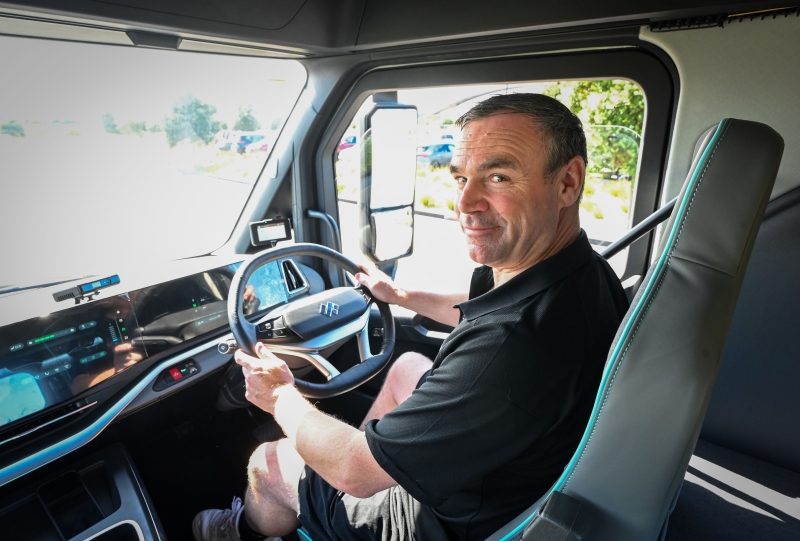
Foodstuffs North Island Safety Compliance Officer Chris King at the co-op's Landing Drive Support Centre.
Foodstuffs North Island Fleet Safety Compliance Officer Chris King says the electric truck performed strongly during a trial in 2025, travelling more than 1,000 kilometres while towing the refrigerated trailer and tackling demanding terrain, such as Transmission Gully.
“It delivers strong torque, which is especially important when hauling heavy loads up steep sections,” King says.
“Compared with a conventional diesel truck it’s also very quiet and smooth to drive, with powerful regenerative braking that reduces heavy braking and helps reduce driver fatigue.”
The vehicle also meets Foodstuffs’ latest fleet safety requirements, including fatigue-monitoring cameras, handbrake alarm systems and left-turn cyclist alerts.
Key specs
- Battery: 600kWh lithium iron phosphate
- Range: Up to 400km at 44 tonnes
- Power: 224kW continuous / 492kW peak
- Torque: 30,000Nm continuous / 75,000Nm peak
- Gross Combination Mass: 50,000kg
Foodstuffs operates one of New Zealand’s largest grocery supply chains, with five distribution centres nationwide and trucks travelling around 30 million kilometres every year.